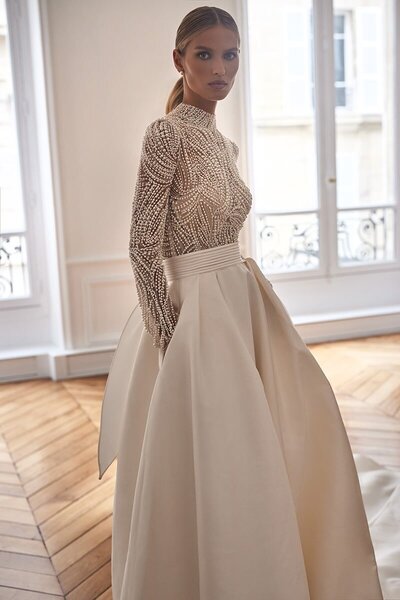
You do not need a perfect bridal style before you shop
Many brides save dozens of wedding-dress photos and still feel unsure how to explain what they want. That is normal. Inspiration images show a complete look, but your real preference may be only one part of each photo: the clean neckline, the soft skirt, the lace pattern, the waist placement, or the way the gown moves.
Your first goal is not to name one exact dress. It is to give your stylist enough useful information to select a thoughtful starting group. The appointment can do the rest.
Begin with the feeling
Before listing dress details, choose three to five words for how you want to feel. You might say polished, romantic, effortless, dramatic, soft, modern, classic, relaxed, structured, glamorous, or understated. These words are not technical, but they help a stylist understand the overall direction.
Then add one contrast. “Romantic, but not overly delicate.” “Modern, but not severe.” “Classic, with one unexpected detail.” The contrast often communicates more than a long list of bridal terms.
A simple style brief
- I want to feel: ______, ______, and ______.
- I am drawn to: ______.
- I would rather avoid: ______.
- Comfort or movement matters because: ______.
- I am open to trying: ______.
Look for patterns in your saved photos
Choose five favorite images—not fifty—and ask what repeats. Ignore the venue, flowers, model, hairstyle, and lighting. Focus only on the dress. Do several gowns have a defined waist? Are the skirts soft or architectural? Do you repeatedly save smooth fabric, dimensional lace, a lower back, sleeves, or a clean neckline?
Write down the repeated details and bring the images. A stylist can help translate what you see into the language used to find gowns.
Use five categories to describe a dress
Shape: Do you picture a close-to-the-body silhouette, a softly flowing skirt, or a fuller skirt with more volume? If you do not know, say so. Trying contrasting shapes early can create useful clarity.
Structure: Decide whether you like a visibly shaped bodice, softer construction, or you are open to both. Describe how supported or relaxed you want to feel rather than guessing at garment construction.
Neckline and coverage: Talk about what you want emphasized and what helps you feel comfortable. Sleeves, straps, strapless necklines, back coverage, and bodice depth can all change the feeling of a gown.
Surface and fabric: You can simply say smooth, textured, lace, sparkly, matte, soft, crisp, or “I want detail that is noticeable only up close.” You do not need to identify the fabric correctly.
Movement and train: Think about walking, sitting, dancing, and the visual impact you want from behind. A train can be a major design feature, while skirt movement can shape how the dress feels all day.
Say what you do not want—with room to be surprised
A short “no” list prevents wasted time, but an overly strict list can hide useful possibilities. Separate firm boundaries from assumptions. A firm boundary might relate to comfort, coverage, mobility, or personal meaning. An assumption sounds more like, “I have never liked that in photos.”
Tell your stylist which is which. It is reasonable to protect a true boundary and still try one strategic wildcard that tests an assumption.
Use your reactions as better language
During the appointment, replace “I just don’t like it” with one specific observation. Try: “I like the waist, but the skirt feels too busy.” “I love the fabric, but I want more movement.” “The neckline feels right, but I want less structure.” Each reaction makes the next dress selection more precise.
Notice what you reach for when you look in the mirror. If you keep touching the neckline, smoothing the skirt, or asking to see the back, that detail may matter more than you expected.
Choose the Reading boutique that matches your starting point
Lace Bridal Couture offers designer gowns in a personal appointment setting with private suites and a stylist focused on the bride’s vision. That environment can suit a bride who wants guided exploration across a curated collection.
Love Curvy Bridal specializes in bridal sizes 16–34. Brides who want a size-inclusive collection can bring the same feeling words, saved patterns, and comfort priorities to the appointment.
Reading Bridal Outlet offers off-the-rack wedding dresses from a changing collection, with the option to take a purchased gown home the same day. A flexible style brief is especially useful when discovery is part of the experience.
What to say when the appointment begins
You can keep it simple: “I am still learning my style. I want to feel modern and confident, with some softness. I keep saving clean necklines and textured skirts. I do not want to feel restricted, and I am open to one or two shapes I have not considered.”
That is enough to begin. Your stylist does not need a perfect answer; your stylist needs honest information. The right vocabulary often appears only after you see yourself in the first few gowns.
Let your style become clearer in the fitting room
A wedding dress is experienced in three dimensions. It has weight, movement, structure, texture, and a relationship to your body that a saved photo cannot show. Use inspiration as a starting point, not a contract. The most useful outcome of your appointment may be discovering that your real style is more specific—and more personal—than the labels you brought with you.